ARPANET's First Message: "LO" and the Crash That Started the Internet
On October 29, 1969, a student at UCLA tried to type "LOGIN" to a computer 350 miles away. He got two letters in before the system crashed. Those two letters—"LO"—became the first message ever sent over the network that would become the internet.
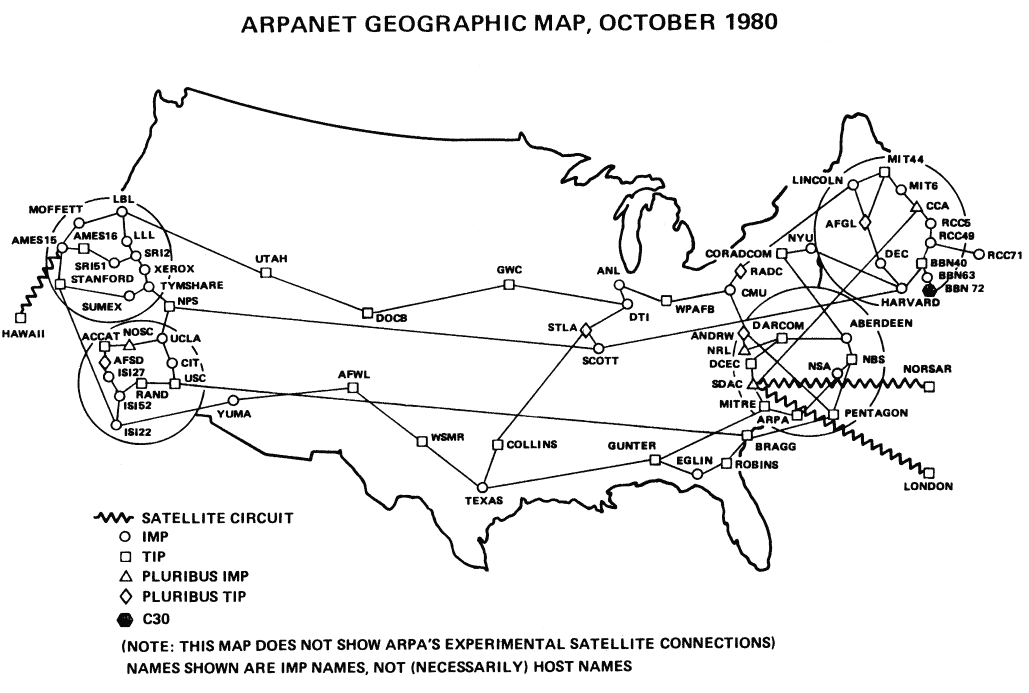
Table of Contents
- The Night Everything Changed
- The Problem They Were Solving
- The Technology: IMPs and Packet Switching
- The First Connection Attempt
- Why "LO" Was Perfect
- What Happened Next
- The People Behind the Message
- From Four Nodes to Billions
- Conclusion
The Night Everything Changed
It was 10:30 PM on October 29, 1969. In a computer lab at UCLA, a 21-year-old student programmer named Charley Kline sat at a terminal connected to a Scientific Data Systems Sigma 7 computer. 350 miles north at the Stanford Research Institute (SRI), another programmer named Bill Duvall waited at an identical setup.
Between them: a 50-kilobit-per-second phone line and a pair of refrigerator-sized boxes called Interface Message Processors (IMPs). Their goal was simple—send a message from one computer to another over this experimental network. They would attempt to log into the Stanford computer from UCLA.
The two programmers were connected by a regular telephone headset, coordinating their actions in real-time like pilots running through a pre-flight checklist.
"Okay, we're going to type the 'L' in LOGIN," Kline said.
"Did you get the 'L'?" he asked.
"Yep, got the 'L'," Duvall confirmed from Stanford.
"Okay, here comes the 'O'."
"Got the 'O'."
"Now sending the 'G'—"
The system crashed.
The Stanford computer, overwhelmed by the incoming data, simply stopped responding. The first message ever transmitted over the ARPANET wasn't "LOGIN"—it was "LO."
The Problem They Were Solving
To understand why this moment mattered, you need to understand the problem they were trying to solve.
In the 1960s, computers were massive, expensive machines owned primarily by universities, government agencies, and large corporations. Each computer was isolated—an island of computing power with no way to communicate with other systems. If a researcher at UCLA wanted to use a specialized program running on a computer at Stanford, they had two options:
- Travel to Stanford (expensive, time-consuming)
- Mail magnetic tapes back and forth (even slower)
Neither option was practical for the kind of rapid information sharing that scientific research demanded.
The Military's Interest
The Advanced Research Projects Agency (ARPA)—the research arm of the U.S. Department of Defense—had another concern. During the Cold War, the military needed a communication network that could survive a nuclear attack. Traditional phone networks were centralized: if a key switching station was destroyed, large portions of the network would go down.
ARPA wanted something different: a decentralized network where data could find multiple paths to its destination. If one route was blocked or destroyed, the network would automatically route around the damage.
The solution was ARPANET—the Advanced Research Projects Agency Network—which would connect computers at universities and research institutions across the country.
The Technology: IMPs and Packet Switching
The breakthrough that made ARPANET possible was called packet switching, a concept developed independently by Paul Baran at RAND Corporation and Donald Davies at the UK's National Physical Laboratory.
How Packet Switching Worked
Instead of establishing a dedicated circuit between two computers (like a traditional phone call), packet switching broke messages into small chunks called "packets." Each packet contained:
- The actual data being sent
- The source address (where it came from)
- The destination address (where it's going)
- Sequence information (so packets could be reassembled in the right order)
These packets could take different routes through the network and be reassembled at the destination. If one path was congested or down, packets could automatically reroute.
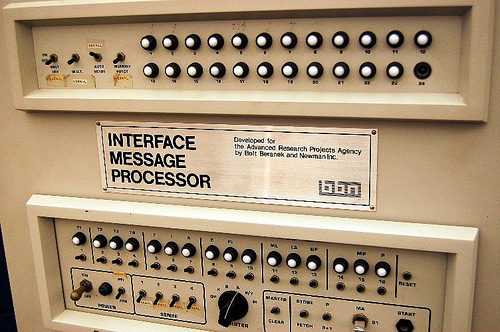
The Interface Message Processor (IMP)
The hardware that made this work was the Interface Message Processor, built by Bolt, Beranek and Newman (BBN) based on a Honeywell DDP-516 minicomputer. Each IMP was about the size of a refrigerator and cost roughly $80,000 (equivalent to about $650,000 today).
The IMP's job was to: - Accept data from the host computer - Break it into packets - Forward packets to the next IMP in the network - Receive packets from other IMPs - Reassemble packets and deliver them to the host computer
On August 30, 1969, the first IMP was installed at UCLA. The second arrived at Stanford Research Institute on October 1, 1969. By the end of October, they were ready to attempt the first connection.
The First Connection Attempt
The setup for that historic night was deceptively simple. Charley Kline would use a program running on the UCLA computer to attempt a remote login to the SRI computer. The command was straightforward: type "LOGIN" followed by a username and password.
But nothing about this was routine. No one had ever done this before. Every keystroke was being transmitted as packets across phone lines, through IMPs that were still being tested and debugged.
Letter by Letter
The process was painstakingly slow. Each letter had to be transmitted, received, and acknowledged before the next one could be sent.
"L" — success. "O" — success. "G" — crash.
As Bill Duvall later recalled in interviews, the SRI computer simply couldn't handle the incoming data. The receiving system's memory buffer overflowed, causing the host computer to freeze.
Charley Kline dutifully recorded the event in his logbook:
"22:30 Talked to SRI Host to Host" "CSK"
That simple notation marked the moment everything changed.
The Second Attempt
About an hour later, after debugging and adjusting the systems, they tried again. This time, the full "LOGIN" message went through successfully. They had established the first host-to-host connection on ARPANET.
But history remembers "LO"—the crash, the imperfection, the moment when humanity's ambitions temporarily exceeded what the technology could handle.
Why "LO" Was Perfect
The accidental message "LO" turned out to be strangely prophetic. Consider:
"LO" resembles "Hello"—a greeting, the start of a conversation that would eventually connect billions of people.
"LO" also suggests "lo and behold"—drawing attention to something remarkable, which this certainly was.
The crash itself demonstrated exactly why packet switching and robust networking protocols were necessary. If the network couldn't handle a simple five-letter word, clearly more work needed to be done.
Compare this to other famous "first messages" in communication technology:
- Telegraph (1844): Samuel Morse sent "What hath God wrought"—a complete, carefully chosen biblical quotation
- Telephone (1876): Alexander Graham Bell said "Mr. Watson, come here, I want to see you"—a complete sentence with purpose
- ARPANET (1969): "LO" followed by a system crash
The internet's first message was imperfect, incomplete, and required a second try. In retrospect, this seems fitting for a technology that would be defined by its resilience, its ability to route around failures, and its philosophy of "good enough" rather than perfect.
What Happened Next
The ARPANET grew rapidly:
December 1969: UC Santa Barbara and the University of Utah join the network (four nodes total)
1970: The Network Control Protocol (NCP) is developed, allowing different computers to communicate more reliably
1971: 15 nodes connected, including MIT and Harvard
1972: Ray Tomlinson sends the first email over ARPANET (and chooses the @ symbol for email addresses)
1973: ARPANET gets its first international connections (University College London and Royal Radar Establishment in Norway)
1974: Vint Cerf and Bob Kahn publish a paper describing TCP (Transmission Control Protocol), which would eventually replace NCP
1983: ARPANET officially switches from NCP to TCP/IP on January 1—often called "Flag Day"—creating the technical foundation of the modern internet
1990: ARPANET is officially decommissioned, having been superseded by the Internet
The People Behind the Message
Charley Kline
The student who typed those first two letters went on to a long career in computing. In later interviews, Kline was characteristically modest about his role: "I'm the one who was there, but there were a lot of people involved." He kept the original logbook, which is now a treasured artifact of computing history.
Bill Duvall
The programmer on the receiving end at Stanford continued working in networking and distributed systems. He emphasized that the achievement was a team effort: "There were a lot of people working very hard to make this happen."
Leonard Kleinrock
The UCLA professor whose lab hosted the first ARPANET node. Kleinrock had written his Ph.D. dissertation on packet switching in 1961-62 (before the term "packet switching" even existed). His theoretical work provided much of the foundation for ARPANET.
The BBN Team
The engineers at Bolt, Beranek and Newman who built the IMPs, including: - Frank Heart (led the IMP team) - Robert Kahn (later co-invented TCP/IP) - Dave Walden (hardware architecture) - Severo Ornstein (hardware design) - Will Crowther (programmer, who later created the first text adventure game, Colossal Cave Adventure)
Lawrence Roberts
ARPA program manager who championed the ARPANET project and drove its development.
From Four Nodes to Billions
Today, the descendant of that experimental network connects over 5 billion people worldwide. Every time you:
- Send an email
- Load a web page
- Stream a video
- Make a video call
- Send a text message over WiFi
- Update an app
- Check social media
...you're using technology that traces directly back to that night in 1969 when two computers 350 miles apart successfully exchanged the letters "L" and "O."
The Internet's 50th Birthday
In 2019, the internet celebrated its 50th anniversary. UCLA held a commemoration event, and many of the original ARPANET pioneers gathered to reflect on what they'd created.
What started as a military research project to create a resilient communication network became the most transformative technology of the modern age. The network designed to survive a nuclear war instead connected humanity in ways its creators never imagined.
The Technical Legacy
The principles established by ARPANET remain fundamental to the internet today:
Packet Switching: Still the core method for transmitting data across networks
End-to-End Principle: Intelligence at the edges of the network, not in the middle—allowing innovation without asking permission from network operators
Decentralization: No single point of failure or control
Open Standards: TCP/IP and other protocols are publicly documented, allowing anyone to build compatible systems
Redundancy: Multiple paths between any two points, automatically routing around failures
Conclusion
The story of "LO" captures something essential about technological progress. It wasn't a triumphant moment with a perfectly executed demo and inspiring speeches. It was two programmers on a phone, carefully trying to make two computers talk to each other, hitting a problem, debugging it, and trying again.
The crash that interrupted "LOGIN" wasn't a failure—it was the first of countless problems that would need to be solved to make networked computing work at scale. Each crash, each bug, each unexpected interaction taught the pioneers of networking something new about how to build robust, resilient systems.
Fifty-five years later, the network they started with four nodes has grown beyond anyone's wildest predictions. The internet has reshaped human communication, commerce, education, entertainment, and society itself.
And it all started with "LO"—two letters and a crash, recorded in a logbook by a grad student who probably had no idea he was making history.
Fun Fact: The original IMP logbook page from October 29, 1969, still exists. It's a simple handwritten note: "22:30 Talked to SRI Host to Host" with Charley Kline's initials "CSK" below. This understated documentation of one of computing's most important moments is now preserved in UCLA's archives.
Interested in more computing history? Learn about the first actual computer bug—a real moth, or discover how two programmers created sudo to solve Unix's biggest security problem.