The Dawn of Computing: Vacuum Tubes and the Birth of Programming
In the early days of computing, programmers worked with machines that used vacuum tubes to process information. These room-sized behemoths were the precursors to modern computers and represent a fascinating chapter in technological history. In this blog post, we'll explore vacuum tube computing, how these machines were actually programmed, and the surprising origin of a term every programmer knows today: the "bug."
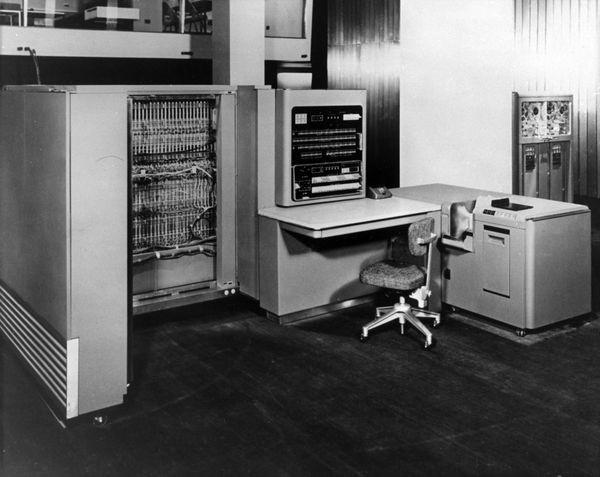
Table of Contents
- What Were Vacuum Tube Computers?
- How Vacuum Tubes Worked
- Programming Without Code
- The Origin of the Word "Bug"
- Notable Vacuum Tube Computers
- The Transition to Transistors
- Conclusion
What Were Vacuum Tube Computers?
The use of vacuum tubes in computing dates back to the 1940s, when the first electronic computers were developed. These machines used thousands of vacuum tubes—glass bulbs that controlled electrical current—to perform calculations and store data. They consumed enormous amounts of power, generated tremendous heat, and required entire rooms to house them.
The ENIAC (Electronic Numerical Integrator and Computer), completed in 1945, contained approximately 17,468 vacuum tubes, weighed 30 tons, and consumed 150 kilowatts of power. Despite these limitations, these machines represented a revolutionary leap from mechanical calculators.
How Vacuum Tubes Worked
A vacuum tube (also called a thermionic valve) controls the flow of electrical current through a vacuum inside a sealed glass container. The basic triode tube contains three elements: a heated cathode that emits electrons, a metal plate (anode) that collects them, and a grid that controls the electron flow between them.
By varying the voltage on the grid, the tube could act as a switch—the fundamental building block of digital logic. Multiple tubes working together could perform binary arithmetic, with tubes representing either "on" (1) or "off" (0) states.

The main challenges with vacuum tubes included:
- Heat generation: Tubes ran hot, requiring significant cooling and causing frequent failures
- Power consumption: Large installations required dedicated power supplies
- Reliability: Tubes burned out frequently, requiring constant maintenance
- Size: Each tube was roughly the size of a light bulb
Programming Without Code
Programming early vacuum tube computers looked nothing like modern software development. There were no keyboards, no screens, and no programming languages as we know them today.
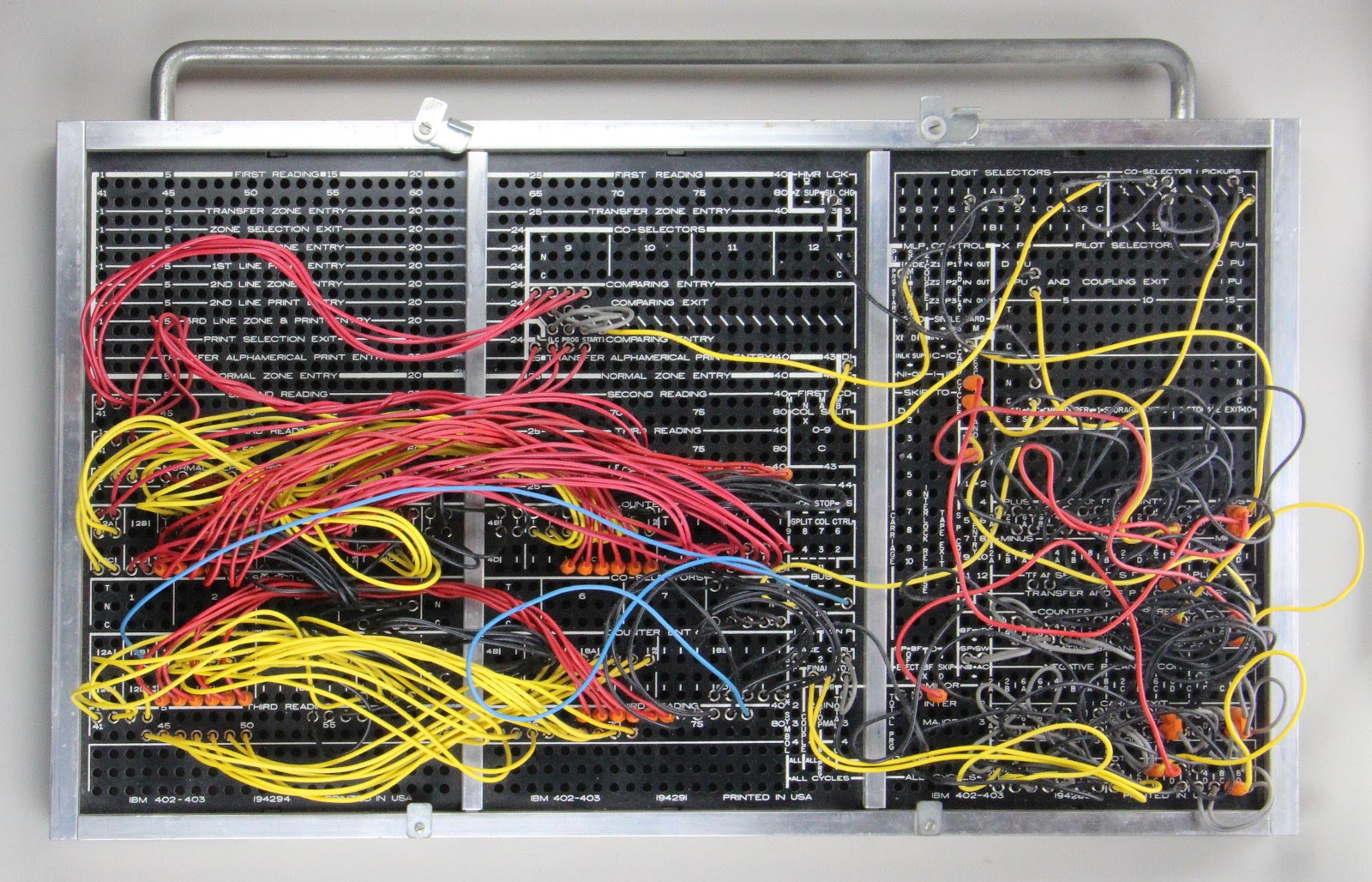
Plugboards and Patch Cables
The ENIAC was programmed by physically rewiring the machine. Operators (often women mathematicians known as "computers") would spend days connecting cables between different units and setting thousands of switches to configure the machine for a specific calculation. Each new problem required a complete reconfiguration.
Punched Cards and Paper Tape
Input and output often relied on punched cards or paper tape. Operators would encode instructions and data by punching holes in specific patterns. The machine would read these holes as binary data.
The First Stored Programs
A major breakthrough came with stored-program computers like the Manchester Baby (1948) and EDSAC (1949), which could store instructions in memory rather than requiring physical rewiring. This concept, often attributed to John von Neumann, forms the basis of virtually all modern computers.
The Origin of the Word "Bug"
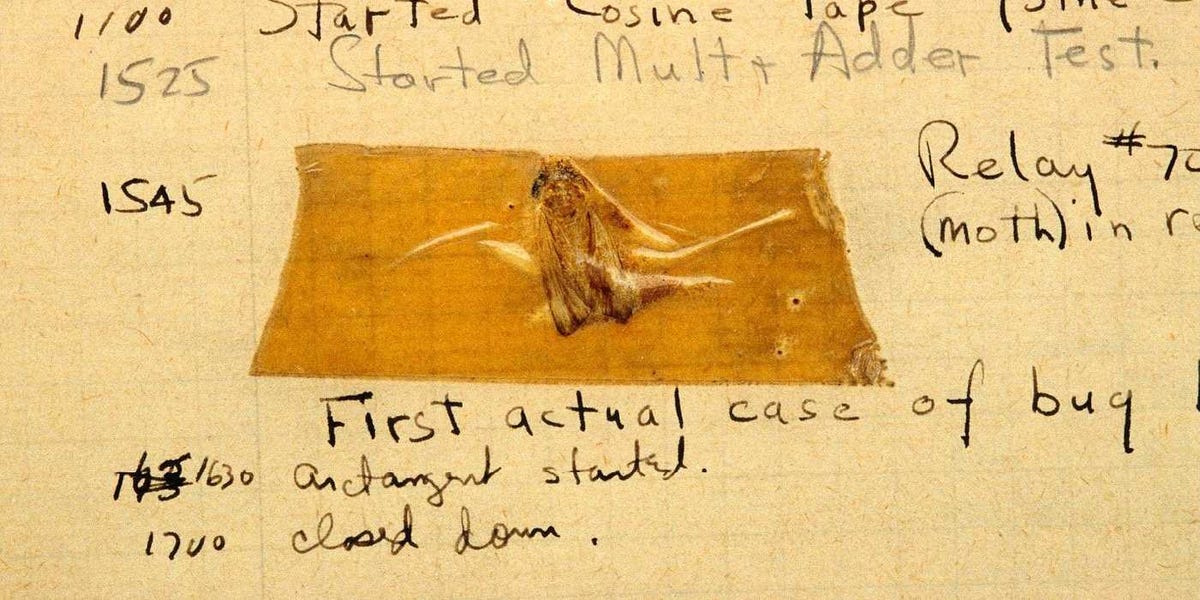
One of computing's most enduring terms has a surprisingly literal origin. On September 9, 1947, operators working on the Harvard Mark II computer (an electromechanical computer, technically using relays rather than vacuum tubes) discovered that a moth had become trapped in one of the relays, causing a malfunction.
Grace Hopper, the pioneering computer scientist working with the team, taped the moth into the logbook with the notation: "First actual case of bug being found." The logbook page, complete with the moth, is now preserved at the Smithsonian Institution.
While the term "bug" for a technical glitch predates this incident—Thomas Edison used it in the 1870s to describe technical problems—this famous moth gave the computing world its favorite term for software and hardware problems, and "debugging" became the standard term for finding and fixing them.
Notable Vacuum Tube Computers
Several vacuum tube computers made significant contributions to computing history:
- Colossus (1943-1944): Built in Britain to break German codes during World War II, it was one of the first electronic digital computers
- ENIAC (1945): The first general-purpose electronic computer, originally designed to calculate artillery firing tables
- UNIVAC I (1951): The first commercially produced computer in the United States, famous for predicting Eisenhower's 1952 election victory
- IBM 701 (1952): IBM's first commercial scientific computer
The Transition to Transistors
By the late 1950s, transistors began replacing vacuum tubes. These solid-state devices were smaller, more reliable, generated less heat, and consumed far less power. The transition marked the beginning of the "second generation" of computers and paved the way for the integrated circuits and microprocessors that power today's devices.
A single modern smartphone contains billions of transistors—more computing power than all the vacuum tube computers ever built, combined.
Conclusion
Vacuum tube computers represent a pivotal moment in technological history. Despite their size, heat, and unreliability, they proved that electronic computation was possible and laid the groundwork for everything that followed. The programmers who worked with these machines—often reconfiguring hardware by hand—developed the foundational concepts that still underpin computing today.
And every time a programmer hunts for a bug in their code, they're connecting to a tradition that stretches back to that famous moth in 1947.
Note: The vacuum tube era lasted roughly from the mid-1940s to the late 1950s—just over a decade—yet the innovations from this period continue to influence computing to this day.